Blended Intensive Program: CERN Particle Accelerator IoT
Overview
I participated in an international Blended Intensive Program (BIP) hosted at TH Köln in Germany. We were tasked with a shared global goal: building a synchronized, networked IoT model of the CERN Particle Accelerator. Each team was responsible for a specific section—ours was the Linac4—requiring perfect technical alignment to ensure the entire system functioned as a single unit.
Why I Joined
I joined this program to move beyond isolated projects and work on a distributed system. I wanted to see how my code and hardware schematics would interact with components built by people from different countries and engineering backgrounds.
Working in a Multicultural Team
This was my first time collaborating so closely with a team of people I had never met.
- Adapting to Communication: I learned to adapt my technical explanations to ensure everyone—regardless of their primary language—was on the same page.
- Building Trust: We had to build a functional working relationship in just a few days. This taught me how to be patient, listen actively, and find common ground quickly to meet a tight deadline.
The Task: The Linac4 (Linear Accelerator)
My team was assigned the Linac4. Our challenge was to design the hardware and IoT logic so that our "node" could receive data and pass it to the next team’s module seamlessly, mimicking the flow of a real particle accelerator.
How We Built It
- Virtual Pre-Phase (Research & Planning): We began with virtual sessions to study the CERN accelerator’s mechanics. We used this time to define our task, plan our technical roadmap, and establish CAN-bus as the messaging standard for our ESP32 microcontrollers.
- Intensive Week in Cologne (The Prototype Sprint):
- Hardware Assembly: We spent the week at TH Köln soldering our custom boards and designing the hardware schematics from scratch.
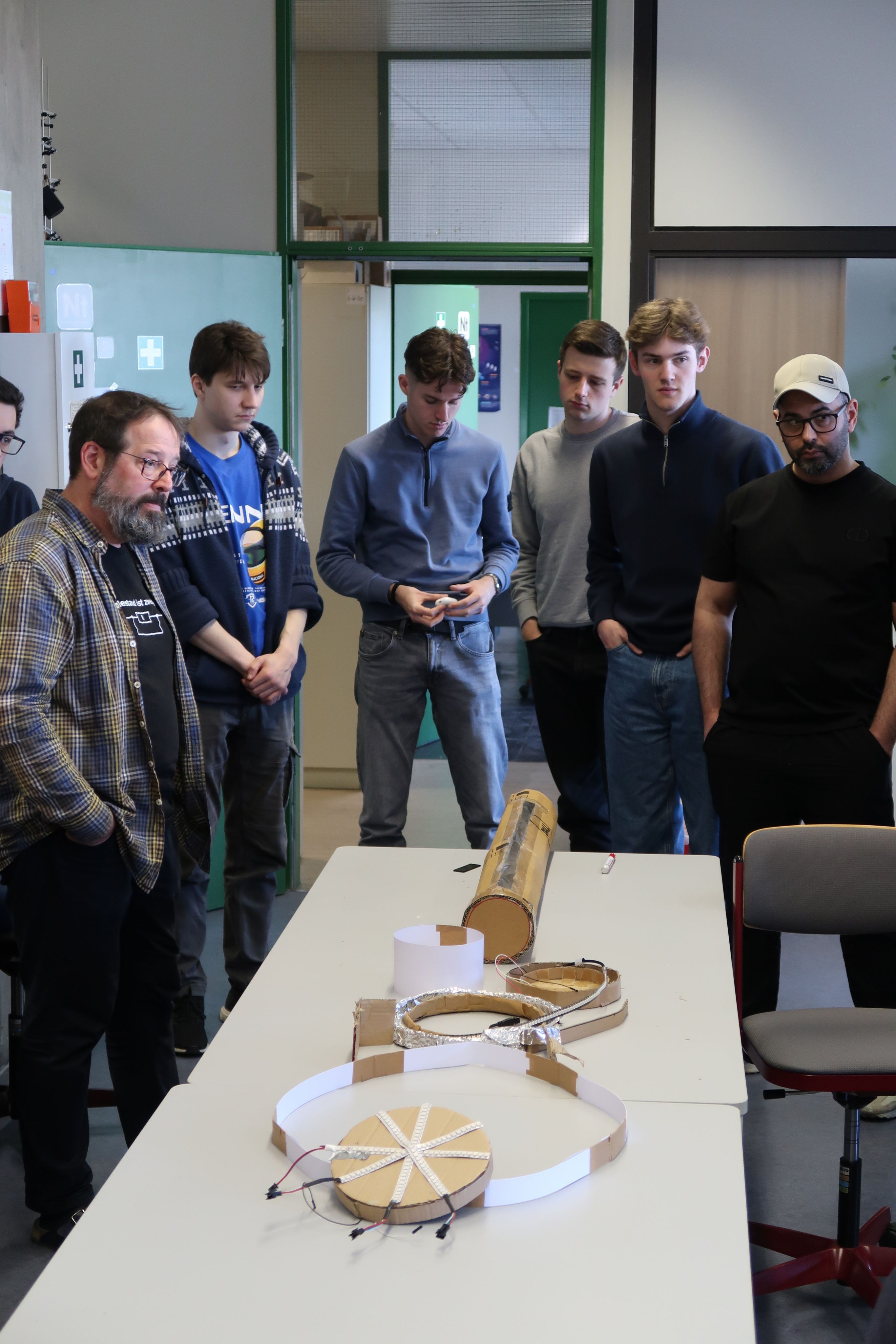
- Rapid Prototyping: We built our first working model using cardboard for the housing. This "low-fidelity" approach allowed us to focus entirely on the electronics and ensuring the CAN-bus communication with other teams worked perfectly.
- System Integration: By the end of the week, we had a functional prototype with synchronized code and a 3D-model vision for the final housing.
My Contribution: Technical Anchor & Lead Mediator
- Firmware & Hardware Lead: I designed the hardware schematics and took over the firmware development. After a teammate’s AI-generated logic proved to be dysfunctional "slop," I rewrote the majority of the codebase. I ensured the LED speeds synchronized with the accelerator's timing and that the CAN-bus messaging was stable.
- Conflict Resolution: I served as the main point of contact between our group and the other international teams. Internally, I stepped in as a mediator to resolve a serious conflict regarding a breach of trust over "stolen" code, successfully refocusing the team on the final goal.
Tech Stack
- Environment: PlatformIO
- Hardware: ESP32, CAN-bus Transceivers, Custom Hardware Schematics
- Protocols: CAN-bus, Serial Communication
Key Takeaways
- Cultural Intelligence: Technical skill is only half the battle; the ability to collaborate with people from different backgrounds is what actually gets a project across the finish line.
- The Value of Prototyping: Soldering and testing on a cardboard model taught me to prioritize functional communication before worrying about final aesthetics.
- Leadership under Pressure: Handling "AI slop" and internal team friction in a foreign country taught me how to maintain professional standards and lead through a crisis.